The Mercedes-Benz C-Class Saloon and Estate receive a substantial technical update covering their engines, chassis, electronics and interior. Following the European introduction of the electric C-Class, the combustion-engined models retain petrol, diesel and plug-in hybrid options. Mercedes-Benz describes the changes as the most extensive technical revision in the model family’s history.
Swiss ordering and the announcement of prices were scheduled for 18 August 2026. No Swiss prices are available here. The C-Class lineage dates back to 1982 and has accumulated more than twelve million sales.
Revised grille and star-shaped lighting
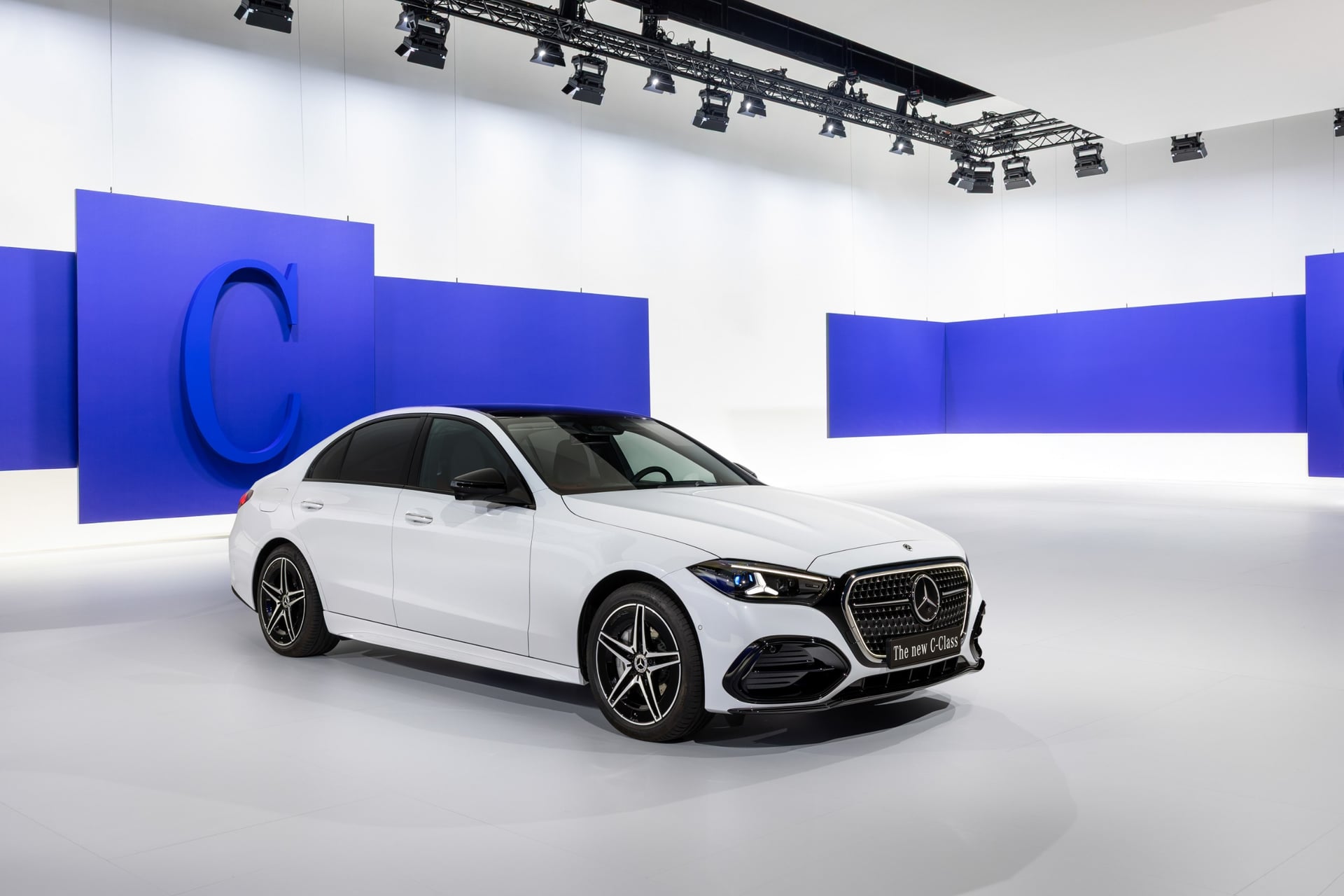
The redesigned grille has a more upright appearance, chrome-look star detailing and an illuminated surround. Illumination of the central star depends on the market. A gloss-black panel links the grille to new headlights with star-shaped daytime running lights; the Saloon’s rear lights also adopt a star motif.
Reshaped bumpers, sill-mounted light projectors and exterior mirrors that project the Mercedes star add further changes. Wheel sizes range from 17 to 19 inches, including a new 18-inch design and two new 19-inch AMG designs. Lavender silver metallic and moody sky grey metallic join the paint selection.
AMG Line Plus becomes available for the first time. It adds the Night Package, gloss-black exhaust trim and spoiler lip, sports seats with an integrated-seat appearance, red stitching and red seat belts.
Petrol, diesel and plug-in hybrid options
The revised four-cylinder petrol and diesel engines use a 48-volt system and second-generation integrated starter-generator. Its contribution reaches 17 kW and 205 Nm, supporting low-speed response, recuperation, engine-off coasting and restarting. The engine range has been developed with the forthcoming Euro 7 requirements in mind.
The two-litre M 254 EVO petrol engine gains an electric auxiliary compressor to bridge turbocharger response delays. Outputs range from 130 kW in the C 200 to 190 kW in the C 300. The OM 654 EVO diesel comes in 120 kW and 147 kW versions, with variable turbine geometry and 2,200-bar common-rail injection. It is compatible with HVO100, B10 and B20 fuels.
Plug-in hybrids combine the revised petrol engine with an electric motor, with rear-wheel-drive and all-wheel-drive versions in the range. The C 400 e 4MATIC Saloon and Estate deliver up to 290 kW and 650 Nm. Their 19.53 kWh usable battery supports up to 100 km of WLTP electric range, with charging at up to 11 kW AC or 55 kW DC. Actual range varies with conditions and use.
Chassis, comfort and load space
Revised suspension mounting and adjustable damping target reduced body movement. The layout retains four links per front wheel and a five-link rear axle. Available rear-wheel steering turns through up to 2.5 degrees, cutting the turning circle by 43 cm to 10.64 m. The rear wheels turn opposite to the fronts below 100 km/h and in the same direction above that speed.
Drag coefficients start at 0.24 for the Saloon and 0.26 for the Estate. Revised mirror bases, an additional windscreen seal, insulation changes and a cage-type exhaust mounting address noise and vibration.
The Estate provides 490 litres of luggage space, increasing to 1,510 litres with the rear backrests folded. A 40:20:40 split and powered EASY-PACK tailgate are standard; the luggage cover and partition net have separate cassettes.
MB.OS and a more connected cabin
A 12.3-inch instrument display and 11.9-inch portrait touchscreen accompany a steering wheel with rocker switches and a volume roller. MB.OS supports over-the-air software updates and fourth-generation MBUX, combining ChatGPT, Microsoft Bing and Google Gemini capabilities.
The voice assistant can retain conversational context, find music, provide stock prices and currency conversions, and answer questions about destinations or ski-slope conditions. Google Maps-based navigation integrates Google Cloud’s Automotive AI Agent, including conversational searches for charging and parking availability. Surround Navigation combines a 3D traffic view with guidance; augmented-reality navigation is also available.
Interior additions include beech brown and cherry red upholstery, three new trim finishes, optional multi-contour massage seats and AIR-BALANCE fragrance, ionisation and filtration. Optional Burmester audio features Dolby Atmos, 15 speakers and 710 watts, with ten spatial settings and occupancy-based sound focusing. Ambient lighting offers 64 colours, ten colour themes, five brightness levels and four dimming zones. Some digital functions require activation, subscriptions or separate data services.
Assistance and lighting
Up to ten cameras, five radars and twelve ultrasonic sensors support MB.DRIVE functions. Depending on equipment and market, these include lane changes, distance control, parking, trailer steering assistance and automatic reversing along a previously driven route. ASSIST PLUS can support slowing before stop signs and red lights; ASSIST PRO is initially planned for China. Drivers remain responsible for supervision.
Optional micro-LED DIGITAL LIGHT expands the high-resolution lighting field by around 40%, while Mercedes-Benz quotes energy savings of up to 50% against the previous system. It includes swivelling ULTRA RANGE high beam and adaptive partial high beam.
Key specifications
- Petrol: C 200, 130 kW (177 hp), 270 Nm; C 250, 160 kW (218 hp), 320 Nm; C 300, 190 kW (258 hp), 400 Nm.
- Diesel: 120 kW (163 hp) or 147 kW (200 hp).
- C 400 e 4MATIC: up to 290 kW (395 hp), 650 Nm; usable battery 19.53 kWh; electric range up to 100 km WLTP; charging 11 kW AC/55 kW DC.
- Petrol Saloon combined consumption and CO₂: C 200, 6.8–6.2 l/100 km and 156–141 g/km; C 250, 6.9–6.2 and 156–141; C 300, 7.0–6.3 and 159–144.
- Petrol Estate combined consumption and CO₂: C 200, 7.0–6.4 l/100 km and 161–145 g/km; C 250, 7.1–6.4 and 161–145; C 300, 7.1–6.5 and 162–147.
- C 400 e 4MATIC Saloon, weighted combined: 16.4–15.8 kWh/100 km plus 2.8–2.1 l/100 km; 64–48 g/km CO₂. Discharged-battery consumption: 7.8–6.9 l/100 km.
- C 400 e 4MATIC Estate, weighted combined: 16.6–16.1 kWh/100 km plus 2.9–2.2 l/100 km; 66–51 g/km CO₂. Discharged-battery consumption: 7.9–7.0 l/100 km.